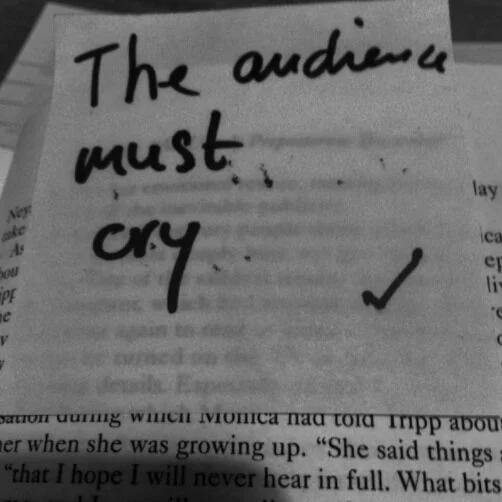
Notes from that time when my director-friend made a play about online bullying
Let me describe a scene to you: it is a busy day at the office. Colleagues bustle about in a workaday-crisis, directing interns this way and that, waving about their documents. And then — in that way that office crises can be diffused in a heartbeat, with cigarette breaks and a call for coffee — silence. A lone intern is left at her desk, hunched over a hefty-looking file. A door opens behind her; a male figure appears. “Can you come here a minute?” Then there’s bodies squeezing through the doorway, hair brushed out of eyes, smiles. Drinks in the office. A slow-dance. Or so… the affair begins.
These events took place on a Monday afternoon, in May, in a classroom at the Birmingham University’s Department of Drama and Theatre Arts. I was there: the protagonists were young actors in rehearsal. They wore trainers and yoga pants and tried out lines and looks and hand gestures, and when the director asked them ‘from the top’ they turned the romantic dancing in a funny skit. The events also took place several weeks later: it was the play opening night, no longer performed in an empty classroom but on a stage, placeholders replaced with actual props and outfits.
A version of these events probably took place in all of our lives, when we were all kids (or older) running into an unfortunate romance.
And the events took place in 1998 — when your average intern fell in love with your above-average boss.
Let me drop the act: the boss was Bill Clinton. The intern was — well, The Intern. Before the play was a play, it was A Scandal.
I borrowed this build-up from Monica Lewinsky herself: she more or less uses the same structure in her TED Talk. In 2015, the most famed and politicized ‘other woman’ resurfaced onto a world stage that she had long sought to avoid, having been all but forced underground by a media storm. For a decade, Lewinsky says, she was “a woman who was publicly silent”. She decided to come back to the forefront, to share with the audience — on her own terms — the lessons she had learnt from her very public shaming. It was a period of time in which she was personally attacked, blamed and made to feel less while the other party — you know, the one she fell in love with — was a political powerhouse that saw a political scandal and a need to control a narrative.
Lewinsky has since come out, turning her own experiences in a public campaign in which she discusses the price of shame. It has a personal price — and a price that is being jacked up by media companies, for clicks and online traffic. Online shame has a price that cannot be erased, and one that is all-consuming. It even takes a toll on those who initially seem to profit — in advertisement and clicks-money, or measured in spending an entertaining minute on their online device — in terms of their humanity. The TED talk went viral: to date, the YouTube video of her speech has been clicked and viewed over 4.5 million times. You should go give it a ‘thumbs up’, as they say in internetspeak.
Loving Monica
I visited the rehearsal space mentioned above upon invitation by my friend Marlien van Liempt. I’m not sure how she found the TED talk — I am guessing it found its way to her, the way Internet things do, from Facebook friend to Facebook friend or through url-links shared in Whatsapp messaging groups. But I do know that when she saw it, it lodged itself quite firmly into her mind.
Marlien is my director-friend. She and I can both spend days obsessing over narratives and politics. We both strive to be relevant. We are both young women who are drawn to active forms of communication. But unlike me, Marlien knows how to make a play.
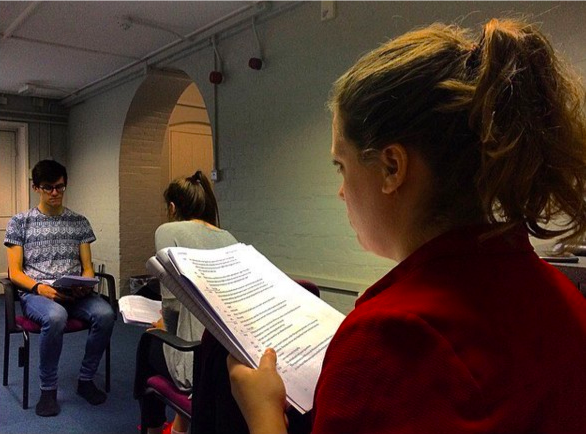
My director-friend Marlien, left, at the Birmingham University campus. And right, in rehearsal with the Blancmontage Theatre Group. To warm up, the actors played the ‘status game’ in which one character has a significantly higher position than the other.
Monica made it into Marlien’s graduating piece.
The play is called Loving Monica.
It is a play about someone, but not really.
As I am working my way through these notes and crunching a deadline, Marlien gives me a call. She’s read the first draft of this post. The play is about to be performed for a fourth and final time, at Birmingham Fest; rehearsals are starting up again. This is the synopsis on the website:
Inspired by Monica Lewinsky’s recent TED talk, the Blancmontage Theatre Group sets out to find the real story behind ‘the White House intern’ and her almost fatal relationship with president of the United States Bill Clinton. Equipped with real material from across the affair, they search for the truth with humour and integrity. Soon, however, moral compasses start to sway, and the actors have to accept their own readiness to judge, belittle and shame.
While this paragraph describes the on-stage events, it also reflects the creation process of the play. After that first rehearsal I get to watch, I sit down with the cast. Jordan Farrag, Jack Davies, Katja de la Fuente, Katy Owens and Georgina Vaughan are all first-years at Birmingham University, soon moving into their second year. With Marlien, they form the Blancmontage Theatre Group.
None of them are old enough to have cared about the Affair when it was unfolded on the web and cable news.
In writing the play, the actors had to delve into a media-vault filled to the brim with sensationalist reporting: newspaper headlines, Grand Jury sessions, FBI investigations. And they touched upon the actual source of these reports: one young person’s private thoughts and feelings. These private words were stolen from seemingly-private conversations, as Monica Lewinsky lays out in her talk. What did the actors make of their ‘subject’? “I — and I think all of us– didn’t know much about her”, says Jordan. His ‘Clinton’ is the man the intern falls in love with. “Well, OK, I knew about the sexual stuff. That’s what I knew. And I distinctly remember: I told my parents about doing this play and their reaction was quite indicative. My mom just went ‘Oh, that poor thing’, or something like that. You know, referring to this whole media circus. But my dad was like”, he wiggles his eyebrows suggestively, “‘Oh, I see, Monica Lewinsky.’ I think they said something about how she was an ‘interesting’ character to be making a play about.”
But actually, Monica is not the character that the play is about — even if she has become the object of obsession for the characters.
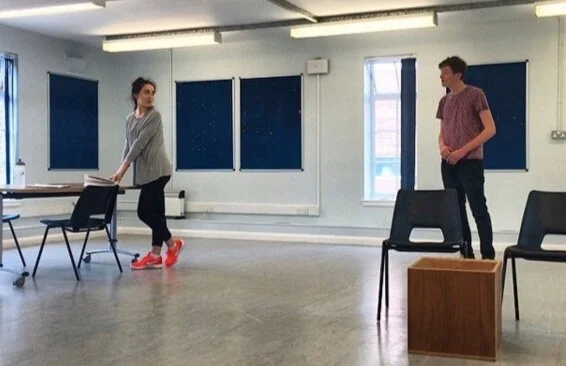
‘Would you come over here a second?’ Rehearsal in Birmingham.
All of the actors were involved in heavy research. Jordan: “And I guess that’s how we came to see Monica as an actual person behind what the media made of her and how our parents, for instance, remember her. It’s just how the media work, isn’t it: they create an image or a scandal.”
In order to get her actors on board, Marlien asked them to investigate that image.
The original tape and films were readily available to the Blancmontage Group — it’s all online. As they used them to gain insight into the historical event, an unease grew: the closer they seemed to be getting to chronologically outline ‘what had happened’, the further away they drifted from being respectful to the person who had suffered its greatest blow. Monica Lewinsky explains this is her TED talk: everytime someone listens to the FBI-tapes of her investigation, she is humiliated again.
This realization is expressed in the play in more ways than one. The shifting personality of ‘Monica’ (from 19-year-old to the 40-something she now is) and how she is perceived, is played by several of the actors — male and female. All of the students play a character that carries their own name (in what I would deem a typically Marlien-esque theatre decision), too, to represent the research process that took place behind-the-scenes.
On the phone, Marlien impresses upon me: “It’s important to understand: what we show on stage, that process of revisiting all of the sources, is pretty awful. The play is about that: a group of people who — even if their intentions started out differently — basically re-stage the nightmarish experience for the subject.” The characters set out to find the ‘real story’. But the actors and their director want you to know: “We’re not saying, ‘This is the truth’. We can’t say that. We wouldn’t want to say that — our point is that this creation of a saucy narrative, the media Scandal, is so harmful to the subject. Our final goal is to display those media mechanisms that profit from a private person’s humiliation, that will force their subject to feel ashamed.”
It is worth pointing out that the mechanism can seem inevitable — I fell into its trap, anyway. Even as I am writing this post to accompany the work the Blancmontage does to expose online shaming, I felt that I could not completely skirt the events that kickstarted the cycle of humiliation for Monica in the first place. I started this text with the Affair.
TED-Monica warns against the wildfire-forms that this mechanism has taken on in the digital age. But it is worth remembering that television, the radio and printed press also employ the same narratives — the intern-Monica was portrayed in the same negative and judgmental light in all media. In bringing this process to the stage, I think Marlien might have broken down a link in the chain of this shaming-process: we see the shaming and narrative-formation in action. At least in the theatre we can get something closer to a 360-degrees-view of what is going on.
Look, Marlien said to me one night after rehearsal, “I still doubt sometimes whether what we do with this play is moral. I don’t know if we can solve anything with putting up this play. But we brought this to a stage. And whether the audience agrees with me or not, or whether we succeed in adjusting these parents’ views of the scandal they remember — they will have to listen.”
When shame is relived in an endless loop
In her TED talk, Monica refers to herself as the ‘patient zero’ of online shaming; when news of the scandal broke, it also broke the newspapers. The first stories came out online, in a pc landscape that is strewn with viruses. Studies show that (false) rumours and allegations spread faster than anything else on social media: verifications and debunked statement barely get any traction. Online shaming is like a dormant disease, or a chronic one that occasionally flares up again to incapacitate the sufferer. Impressions can never be fully erased and online material cannot be taken down.
For any other disease, patient zero is where scientists start their search for a cure: what did they eat? Which places did they visit? Were they in touch with other organisms that might have caused them to contract the disease? But unlike a medical case, the search here cannot be linear like that. The doctors who examine the victim might well cause more harm: any new examination of the scandal again burdens her, says Lewinsky. Maybe we should turn to gaze back upon ourselves: Why do we find this patient and their particular pain so interesting? What is it that causes the public dissection of someone’s personal life to be a source of entertainment for so many of us?
The examination of this virus is a double-edged knife. In Loving Monica, we meet a group of play-actors who actively seek to investigate and cure the patient. They assume the role of ‘the media’ — a biographer (‘Andrew Morton’), a TV-presenter (‘Barbara Walters’) — as they continue to wring every sliver of ‘if’, ‘why’ and ‘how dare she’ from their subject.
What was supposed to be a neat on-stage explainer and the occasion to redeem Monica from that unfair past, runs the risk of becoming another character assassination. This is precisely the point that Marlien and her Blancmontage actors sought to make in Loving Monica. Their characters’ failure to protect Monica once again from the stream of retellings, lays bare the mechanisms through which humiliation is given a perpetual existence on the web.
Character ‘Gina’ thinks herself a doctor who can make Monica whole again. But as she strives to find a cure, not only does that search morph into something much more selfish and prideful — Monica, the idea of who she is and the actors themselves are cut by reliving the events and raking up the investigation, the rumours and the tapes. Through these sources, the on-stage characters once again see Monica as she was portrayed in the late-nineties mass media coverage: as ‘that woman’, whose hysterics, doubts, loves expressed in private phone conversations are played out for the world to hear at their, not her, whims and conditions.
Off-stage Gina tells me it is ‘ironic’: “We are very consciously telling people not to do something that we had to do in order to realize that it wasn’t moral. During the individual research, there were times that I was quite touched. In those tapes you literally skip from donuts to panic attacks. I’m glad we were able to keep a certain degree of separation [from what she must have been going through at the time], because we are making this play, so we do have a certain hat on.”
Her on-stage character does not quite grasp the danger of reviving and re-staging the very events that damaged Monica, says Gina: “Yeah, she doesn’t really learn.” But ‘Katy’, who is assigned the tapes in the course of the play and who portrays Monica in a rendition of the Barbara Walters interview, clearly does. It is a pivotal scene when the character quits rehearsal and turns to the audience. In her hands are clutched the famed telephone tapes; she’d listened to them and feels awful, telling the onlooker: “I thought if I listened hard enough I could be in that same room as her somehow, dry her eyes, hang up her phone, tell her, ‘it’s okay. Someday people will listen in and care about you’.”
It is the old adage that when you tell someone not to do something, they will. And when something lives on the Internet, when its contents — personal shame, regrets, unfortunately-timed pictures of you drunk at a party, that will turn up when strangers Google your name — can be found in digital morsels, they will be. And, finally: if you’ve seen or heard something, there is no way to be made un-aware of it. Nevermind that in the digital age, it cannot even be removed from the web completely. Shame can live on forever. ‘Katy’ again: “Monica had her night wound up in a cassette player a thousand times over and it gets replayed on YouTube every day. And I don’t want you to go and find it, but I think you will. And if you do please, cry. Because if you don’t, if we don’t, if we can’t, then maybe we don’t care.”
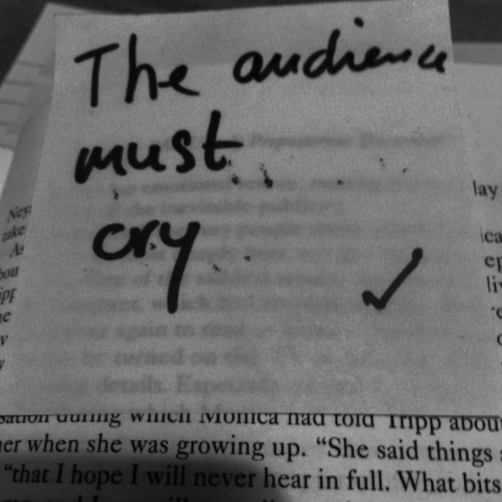
‘The audience must cry’ was one of the notions that the actors decided to explore in ‘Loving Monica’. In telling somebody else’s story, do they have the ‘right’ to dictate the audience’s reaction?
As an actor, Katy told me she was nervous for this scene: “I’d personally never want to want that from my audience — I’d never tell them they have to cry because of something I tell them, it feels like that’s not my place. But it is an interesting notion to explore on the stage. I just don’t think people will start wailing, but maybe they understand the mechanisms we are trying to unravel.”
But when I first saw it, I was left flabbergasted — thanks to its delivery and its message and the profound unease of being a lonely and barely-allowed-to-be-there snooping audience-member in a barren classroom that served as the Blancmontage group’s rehearsal space. I felt like I was being fiercely reprimanded for a streak of curiosity that in its best form allows me to perform a job I dearly love and at its worst, means I gloat at the misfortunes of others. Suffice it to say, it left me flabbergasted.
Well, that’s good, these actors say. Jack explains how the research and rehearsals drove the group to understand the discrepancy and the painful gap between the person-Monica and the humiliations-for-the-world-to-see version of her. “This thought struck me after having done all of the research: what happened to her was devastating. Coming into that one rehearsal — I think it was after having watched the TED talk again — I was just so angry. There’s just no rationale for that kind of [cyber bullying].”
The research for the piece was personal at times. In fact, Marlien made it personal in some of the sessions. Katja, who plays the best Clinton I think I have ever seen (and I’m counting this week’s soppy Convention speech) recalls an assignment to “share your deepest, darkest secrets, basically. And I wasn’t really feeling for that. I didn’t really see that as essential to being able to create a great play. But actually, looking back at it, I do think it was probably smart to have us come together in that way. It was important to have this emotional component — Monica is an emotional person, you know. That’s at least the impression we’re left with, so it was good to be invested in creating this piece.”
I mention that the notion that ‘It could happen to all of us’ is a strong sentiment in our group discussion. “I think we have definitely started thinking more about how we use social media”, said Jordan. “It’s not that I’ve stopped using my phone, but I do realize now how impressions are formed through that kind of communication. And you know you should be careful of what you share online.” But even with this caution, there are factors outside of ourselves that we cannot factor in. We could all fall in love with our boss. It’s an echo of the on-stage ‘Kat’ who refuses to be impressed with the Scandal, as in very first minutes of the play, she scoffs: “People have affairs. Get over it!”
We could also all fell prey to (anonymous) Internet users who take pleasure in or mindlessly click on online content that leaves us mortified. “When you think of what happened … There was a time, when I was in school, someone had spread a rumour about me”, says Jack. “And I wasn’t really bullied or it didn’t get violent, but my classmates heard of it and for a good week I got the piss taken out of me. That was only one week and it ended: that was micro-scale. But she is still in that world.”
In Monica’s story, the classmates have been replaced by everybody with an Internet connection, and all the companies looking to sell online advertisements per click. In our day and age, we are online all the time. In this digital environment, we seek validation and entertainment, as we would in a regular classroom. The line between this entertainment and bullying is frighteningly thin sometimes.
The actors tell me that early on in the process, they thought of inviting Monica to come see the play — but they decided against it, as a form of protection. To invite her to sit through her past ordeal, to witness the Grand Jury procedures, to have her own words played back to her, would achieve the opposite of what they would like to do. It’s as Jack tells me months later, while the audience is filing into the Other Place for Loving Monica’s opening night: “We’ve all come to be protective over her, but also in awe of her and we’ve idolized her a little bit now, I think.”
Or, in other words: the Blancmontage group have figured out that Monica is not ‘sick’ — that her status as ‘patient zero’ is none of her doing, but ours. The sought-after cure is not to ‘rehumanize’ Monica. It is to make sure that we don’t victimize her (again). It is not about a medicine but about a mindset change.
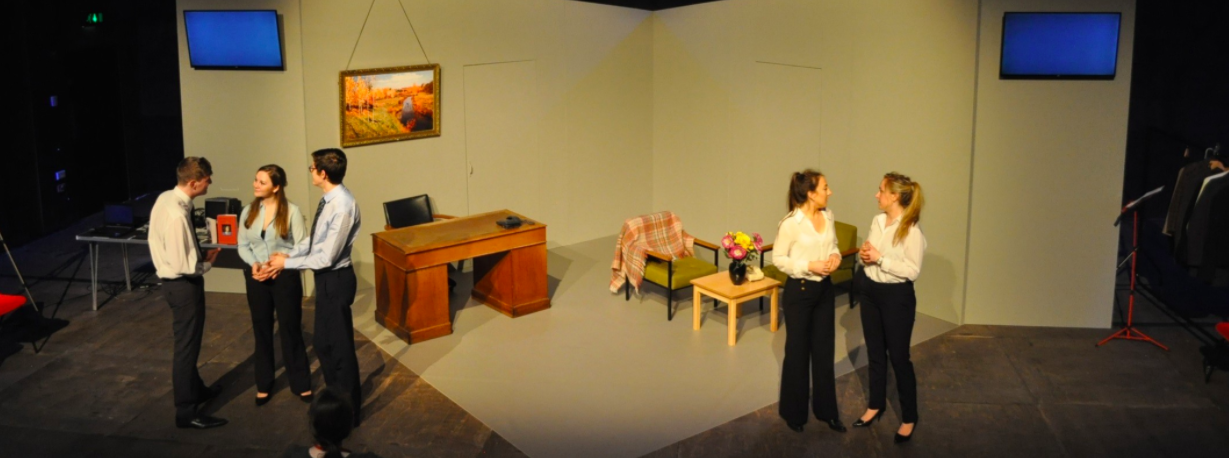
‘Loving Monica’, live on stage at The Other Place in Stratford-upon-Avon. Picture Credit: William Fallows.
Lewinsky in the flesh
As Marlien and her actors move into the last week of rehearsals, Monica Lewinsky comes to the Netherlands. Lewinsky [I’m calling her by her last name here because this is the real Monica] meets with teachers and a group of high schoolers to discuss with them the perils of online relationships and cyberbullying. She attends an event later that night, to deliver the key note speech: a rendition of her TED talk, a compelling call to users of online media to indulge in their favorite pastime with more empathy.
I’ve sat around waiting for her all evening. She must have been present for several hours and heard the same speakers, but she is never to be seen. Only when she is called to the stage is she there; we are being asked not to record or photograph her. The talk sounds rehearsed now — I all but know it by heart myself — , but then she unexpectedly opens the floor for a Q&A. It all but sends me flying off my chair. Earlier that day Marlien texted me a list of questions, which have all evaporated from my mind by the time I am handed the mic. I stumble through my text: That I have a friend who is making a play about her and does she know and how does she feel about people taking up her narrative yet again?
I get a muted response: “I suppose I have mixed feelings about that. I mean — I was not aware that someone was doing that. But it’s great that people are inspired to take my activism forward and that they respond to my message.”
Sat next to me is another friend of Marlien’s. He gets up as soon as I’m done. Lewinsky jokingly states, “Please don’t tell me your friend is making a movie!” Since 2014, Lewinsky has stepped into the limelight again, but it is not to get attention for her personal character or feed-off her ‘fame’. Rather, she is pointing at the deepening shadows that pool around the spotlight.
Above all else, it is clear that Lewinsky is in control during the public speaking engagement. She’s had a hard enough lesson in the workings of narrative construction. Her answers are concise and clipped. She refuses to elaborate on the electoral campaign that features Hillary Clinton, instead focusing on the social activism she has launched. Lewinsky thanks the MC for his introduction, in which he makes no mention of the administration, the White House, or even utters the word ‘affair’. It is the one time when she appears touched.
When the Internet is a stage
I was going to start my notes by writing something intelligent, about how all of us in whichever time we live, create or get the media (platforms) we deserve. But, what do I know.
Two things seem to be happening online at the same time: while anonymity and overall access have hardened those who hold a grudge, the very connection we can form through the web has allowed for a second group of people to become more emphatic. While vicious trolls are willing to treat their keyboards like whetstones on which to grind their souls, others create threads for support and emojis for love. It’s not entirely unthinkable that if the Scandal were to break out in the 2010s, some tribe of internauts and digital social activists would have created a hashtag to express their solidarity (possibly even #LovingMonica?).
I might not remember which classmate had the honour of speaking in name of my own graduating class, but I can all but tearfully recite the inspirational speech that’s been making the rounds on Facebook this week; and there will be another one next week. If you know where to look, that is. In an age in which access to the Internet is regarded as a basic human right, we must also acknowledge that humans could use some instructions on how to safeguard both it, the technology itself, and their use of this extraordinary communications channel. This is the mantra of Lewinsky’s TED, after all: “Click with compassion”.
When it comes to our internet presence, we want to be vulnerable and confessional and at the same time self-protect — or maybe even protect others. Come to think of it, when it comes to our internet presence, we want to be humans. It may come to no surprise to you (you’ve bought tickets to see this play, after all), that I think the stage might just be the best place to actually dissect that human-ness. Welcome to the theatre.